
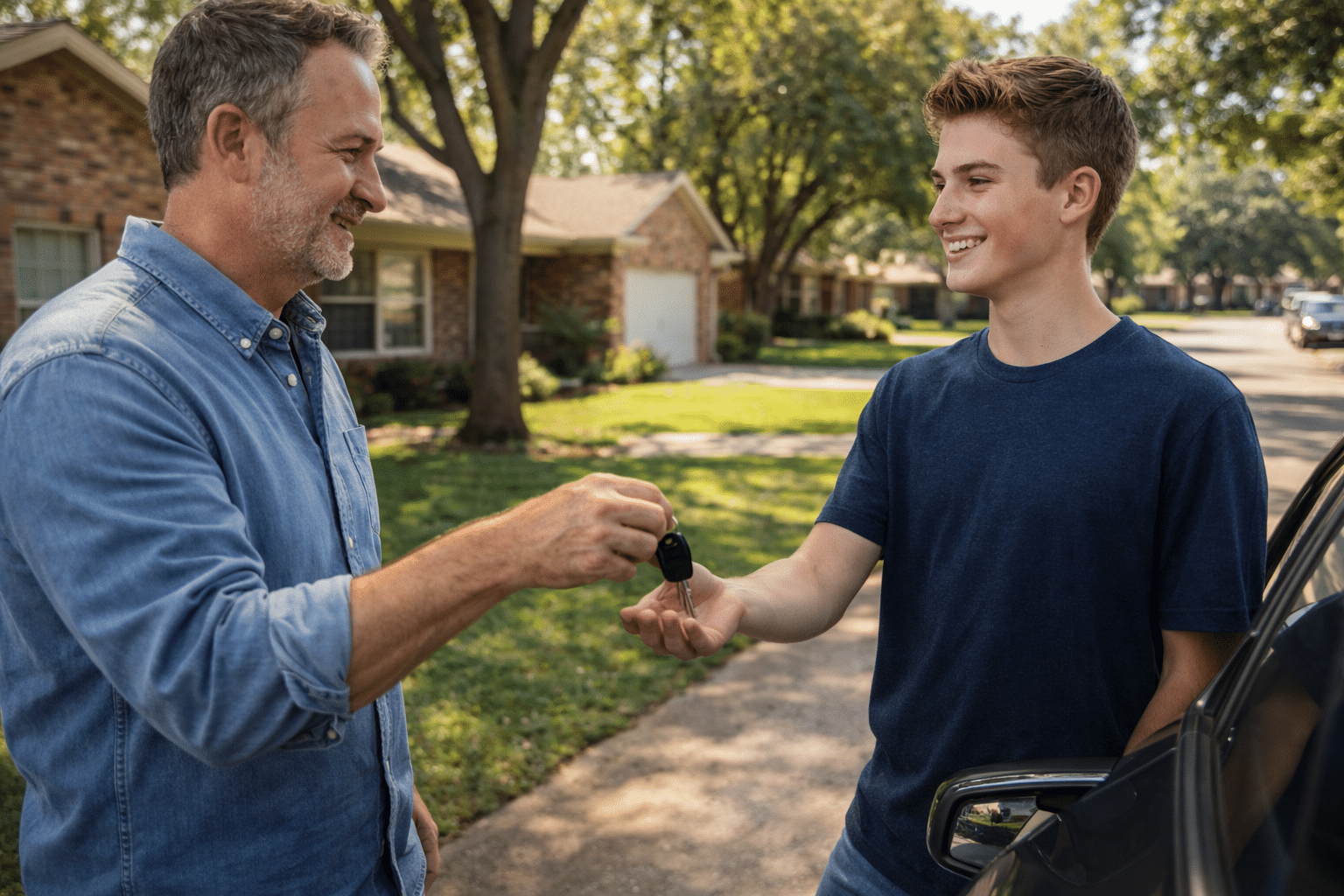
If you have a teenager who just got their learner’s permit — or is about to — you already know what is coming: a conversation with your insurance agent and a bill that is noticeably higher than before.
That premium increase is real. I am not going to pretend otherwise. Teen drivers are statistically the highest-risk group on the road, and insurance pricing reflects that. But there is a right way and a wrong way to handle this moment, and the families who get it right do two things: they add the teen at the correct time (earlier than most parents expect), and they make sure every available discount is applied before they pay a dollar more than they have to.
I have been in Fort Worth for 19 years helping families navigate exactly this situation. I have a master’s in economics and I have written three books on Texas insurance. I understand how the pricing works — and I know where families are being overcharged. This post covers everything you need to know.
When Do You Have to Add a Teen Driver to Your Policy in Texas?
The answer surprises most parents: as soon as your teen gets their learner’s permit — not when they get their license.
Texas uses a Graduated Driver License (GDL) program. A teen can apply for a learner’s permit at age 15. They can move to a restricted license at 16 after completing the required supervised driving hours and driver education. Full, unrestricted driving privileges come at 18.
A lot of parents assume the permit stage is a gray area — the teen has to have a licensed adult in the car, so surely it does not count yet? That logic has real financial risk attached to it.
Here is what matters: if your teen is driving your vehicle and gets into an accident while not listed on your policy, you could face a coverage dispute. Your carrier may not be obligated to pay a claim involving an unlisted household driver. Even if they do pay, not having disclosed the teen creates exposure you do not want.
Texas does not have a separate statute requiring you to add a permit holder, but most carriers require all household drivers to be listed — or explicitly excluded. “Explicitly excluded” is a specific election with its own consequences. Do not leave this ambiguous.
The right move: call your agent the week your teen gets their permit. Do not wait for the license. Do not wait for the next renewal. Call that week.
How Much Does It Cost to Add a Teen Driver in Texas?
This is the question everyone wants answered. I will give you a straight answer: it depends, and anyone who gives you a specific number without knowing your situation is guessing.
What I can tell you is what the variables are. The premium increase for adding a teen driver is influenced by the teen’s age and gender (actuarially relevant in Texas and most states), the vehicle they will primarily drive, your current coverage levels, your location, and — critically — what discounts you qualify for.
What I will not do is quote you a percentage increase or a dollar figure. Every household is different. A parent in Fort Worth driving a five-year-old sedan will have a very different number than a parent driving a newer SUV. The difference between a well-run discount search and a lazy one can be several hundred dollars a year.
That brings me to the part that actually matters.
Discounts That Can Lower the Cost of Insuring a Teen Driver in Texas
These discounts exist. They are real. But they require documentation and a proactive agent. A good agent runs all of them before quoting — you should not have to ask.
Good student discount. Most carriers offer a discount for full-time students who maintain a B average (3.0 GPA) or better. The documentation is usually a current report card or transcript. This discount typically applies until the student reaches a certain age, varies by carrier, and needs to be renewed each year. If your teen is carrying a 3.0 and your agent has never mentioned this, that is worth a conversation.
Driver training discount. Texas requires driver education for teens under 18 as part of the graduated licensing program. That means your teen almost certainly already has the documentation. The question is whether your carrier has it on file. Make sure it is recorded and applied.
Away-at-school discount. If your teen heads to college and lives more than roughly 100 miles from home without bringing a car, your carrier may apply a reduced rate. The logic is straightforward — a student living in a dorm in Austin without a vehicle is not regularly driving the household car in Fort Worth. Distance thresholds vary by carrier, so confirm the exact rule with your agent. This is more relevant for college-bound teens than new permit holders, but worth knowing now.
Multi-policy (bundle) discount. If you carry your home and auto insurance separately, adding a teen driver is a natural moment to ask whether bundling would offset some of the increase. Families who bundle typically get a meaningful discount on both policies. If you have never looked at whether your home and auto are on the same carrier, this is the moment.
Multi-vehicle discount. If your household has more than one vehicle and all of them are on a single policy, you are likely already getting this. If not — or if a vehicle was added since your last review — ask your agent.
Should You Put a Teen Driver on Minimum Coverage to Save Money?
This comes up constantly. My honest answer: no.
Texas law requires a minimum of $30,000 per person / $60,000 per accident for bodily injury liability and $25,000 for property damage (30/60/25, per the Texas Department of Insurance as of this writing). Those are the legal minimums — not a recommendation.
Teen drivers are, statistically, the highest-risk group on the road. That is not a lecture; it is the reason the premium goes up in the first place. An at-fault accident involving a teen driver can easily generate damages that exceed minimum limits — a newer vehicle, a multi-car accident, or a serious injury. When that happens, your family pays the gap out of pocket.
Here is the part that surprises most parents: the cost difference between minimum coverage and meaningful coverage — higher liability limits, uninsured motorist coverage, appropriate collision and comprehensive — is often smaller than you expect. A few extra dollars per month can be the difference between a manageable claim and a financial event that follows your family for years.
My approach with every client: I never start from the minimums. I show you what real protection looks like and what it costs. Then we have an actual conversation about coverage — not a race to the bottom. You decide. But you decide with the real numbers in front of you, not just the legal floor.
One note on collision and comprehensive: Texas law does not require them. But if the vehicle is financed, the lender does. And if the vehicle is paid off, whether it makes sense depends on the car’s value and your financial cushion. That is worth a direct conversation with an agent, not a decision made alone.
Why Adding a Teen Driver Is the Right Time to Review Your Whole Policy
Most people set up their auto and home insurance, then let it auto-renew for years. That is human. It is also how policies drift out of alignment with reality.
A family adding a teen driver has almost certainly had other changes since their last real policy review. The home may have a new roof — or an old one that is now priced differently. Someone in the household may have changed jobs, which can affect rates in ways most people do not realize. A vehicle that was newer when you bought the policy is now five years older, which changes the collision and comprehensive math. Assets and income may have grown, which changes how much liability protection makes sense.
I run a full household discovery checklist with every new client and every reviewing client. Not to find ways to sell more coverage — to make sure the coverage you have actually fits your life right now.
The timing here is practical. If the premium is going up anyway because of the teen driver, this is exactly the moment to look for discounts elsewhere that offset the increase. Bundle discount, multi-vehicle, occupation discount — these add up. Most families I sit down with find at least one gap and often find savings they did not know were available.
A household review takes about 20 minutes. If you are already paying more because of the teen driver, it is worth 20 minutes to make sure everything else is working for you too.
How the Process Works: Adding a Teen Driver Step by Step
When you are ready to call your agent, here is what to have ready and what to expect:
- Call when the permit arrives — do not wait for the license. The permit date is your trigger.
- Have the teen’s full legal name, date of birth, and permit number available. The agent will need these to add them to the policy.
- Know which vehicle the teen will primarily drive — or have access to. This affects how coverage is assigned across the household.
- Ask your agent to run every applicable discount upfront. Good student, driver training, multi-policy, multi-vehicle. Do not wait to be asked.
- Review coverage levels for the whole household while you are on the call. Confirm liability limits, uninsured motorist coverage, and whether collision and comprehensive make sense for each vehicle.
- Ask about the away-at-school discount if college is in the next year or two. It is worth understanding the rules ahead of time so you can apply it the moment it is relevant.
- Get the documentation requirements for the good student discount in writing and note when it needs to be renewed. This is easy to forget at annual renewal.
Your agent should be driving most of this conversation. If they are not bringing up discounts unprompted, that is a signal.
A Note for Fort Worth Military Families
Fort Worth has significant military presence — NAS JRB Fort Worth, Guard units throughout North Texas, and a large veteran community throughout Tarrant County.
If you are active duty, Guard, Reserve, or recently transitioned — there are specific coverage considerations that come with the military lifestyle. Deployments, vehicles in storage, address changes across duty stations, and coverage gaps during PCS moves all create questions that a standard renewal review will not catch.
I have worked alongside Guard and Reserve members through ESGR (Employer Support of the Guard and Reserve) and understand the coverage questions that come with that life. If this is your situation, it is worth a direct conversation.
Adding a Teen Driver Right? Let’s Make Sure.
Adding a teen driver is one of the most significant insurance events a household will go through. Getting it right — the timing, the coverage levels, the discounts, the whole-policy review — matters more than most families realize until something goes wrong.
I have been at the same Fort Worth address on W Vickery Blvd for 19 years. I hold a master’s degree in economics, I have published three books on Texas insurance, and I have helped thousands of North Texas families navigate this exact moment. I understand how insurance pricing models work and I use that knowledge to find where families are being overcharged.
If you are adding a teen driver or just got a renewal notice that surprised you, let’s talk. A household review is free, takes about 20 minutes, and most families find at least one thing worth changing.
Request a free household review at 817Insurance.com — no pressure, no obligation.
David Offutt is a licensed insurance agent (TX License #1465807) based in Fort Worth, TX. He is the author of three books on Texas insurance and the founder of Texas Real Estate Academy, where he teaches insurance continuing education to Texas real estate agents.Frequently Asked Questions
When do I need to add my teen to my car insurance in Texas?
You should add your teen to your car insurance as soon as they receive their learner’s permit — do not wait until they get their full license. If your teen is involved in an accident while driving and is not listed on the policy, you could face a coverage dispute. Calling your agent at the permit stage is the safest move.
What discounts are available for teen drivers in Texas?
Common discounts include the good student discount (typically requires a B average or 3.0 GPA with documentation), the driver training or defensive driving discount, and the away-at-school discount if the teen attends college more than roughly 100 miles from home without a car. Bundling your home and auto policies with the same carrier can also reduce the overall premium. A good agent runs all of these before quoting — you should not have to ask.
Does my teen need their own car insurance policy?
In most cases, no — you add your teen as a driver on your existing household auto policy rather than taking out a separate policy. A separate policy can make sense in specific situations (for example, if the teen has their own vehicle titled in their name), but for most families, listing the teen on the household policy is the standard approach. Your agent can confirm the right structure for your situation.
How much does adding a teen driver raise car insurance rates in Texas?
The cost varies based on your teen’s age and gender, the vehicle they will drive, your current coverage levels, and what discounts apply. Adding a teen driver does raise the premium — teen drivers are statistically higher risk — but discounts like the good student discount, driver training discount, and multi-policy bundling can meaningfully reduce the increase. The best way to know your number is to have an agent run the full discount list before quoting.