The Question Behind the Claim
You filed the claim. The adjuster is scheduled. Now the real question hits: is insurance going to pay for a full roof replacement, or are they just going to patch it?
This is the question homeowners in Fort Worth and across North Texas ask me after almost every major hail event. And it is a good question — because the answer is not as simple as “yes, you are covered.” Coverage is real. But how much you actually receive depends on three things most people have never looked up in their policy: the valuation method, the age of your roof, and what the adjuster decides about scope.
Let me break each one down.
RCV vs. ACV — The Biggest Factor Most Homeowners Miss
Your policy pays out one of two ways: replacement cost value (RCV) or actual cash value (ACV). This single distinction determines whether you get a check that covers a new roof — or a check that leaves you short.
Replacement Cost Value (RCV)
An RCV policy pays what it actually costs to replace your roof with similar materials at today’s prices. If your 15-year-old roof is destroyed by hail, the insurer calculates what a new comparable roof costs to install — and pays that amount, minus your deductible.
RCV is the stronger coverage. Most standard homeowners policies in Texas are written on an RCV basis. But not all of them stay that way.
Actual Cash Value (ACV)
An ACV policy pays the depreciated value of your roof at the time of the loss. Depreciation accounts for age, wear, and expected remaining useful life. A roof installed 12 years ago on a 20-year shingle is not worth what it cost new. The insurer calculates what it was worth right before the storm — not what it costs to replace it — and that is what they pay.
On a roof that is 10-15 years old, the gap between ACV and full replacement cost can easily be $5,000 to $15,000 or more. That gap comes out of your pocket.
ACV coverage on roofs is increasingly common in Texas. Carriers have restructured policies after years of high hail claim volume in the state. Some policies switched to ACV for roofs at renewal — without homeowners realizing it. Check your policy now, not after a storm.
If you have not looked at your deductible lately either, our post on the 2% hail deductible covers what that math looks like on a typical North Texas home.
How Texas Policies Handle Roof Age
Even if your policy is written on an RCV basis overall, many Texas carriers now apply age-based schedules specifically to roofs. Here is how that typically works:
- Roofs under 10 years old — often paid at full replacement cost
- Roofs 10-15 years old — may trigger a depreciation deduction or switch to ACV
- Roofs over 15 years old — some carriers will only pay ACV regardless of the base policy type
The thresholds vary by carrier and policy. Some use roof material as a factor (metal vs. asphalt shingle vs. tile). Others apply a flat age cutoff across the board.
There is also a cosmetic damage exclusion that shows up in some Texas policies — particularly for metal roofing. If hail dents your metal roof but does not compromise its function or cause leaks, some policies explicitly exclude that claim. The roof is cosmetically damaged but not structurally impaired, and the carrier does not pay.
For a deeper look at what is covered and what is not, our post on hail damage coverage in Texas walks through the full picture.
What “Matching” Means — and Why It Matters
Here is a scenario that comes up more often than people expect: the storm only damages one side of your roof. The back slope takes direct hits. The front slope is untouched.
The adjuster scopes the damage to the back slope only and writes up a partial replacement. Your insurer pays to replace that section. But the new shingles do not match the color of the existing shingles — your original color has been discontinued, or it has faded over 10 years in the Texas sun.
Does insurance have to replace the whole roof so it matches?
Texas law does not mandate a uniform matching standard the way some states do. Some policies include a matching endorsement that requires the insurer to achieve a reasonable match — which can mean replacing the entire roof. Most standard policies do not include this language by default.
If matching matters to you, ask your agent specifically whether your policy includes a matching provision. It is an endorsement, not a default term.
How the Adjuster Determines Full Replacement vs. Repair
When the adjuster comes out, they are evaluating two things: the extent of the damage and whether the roof can be functionally repaired or must be replaced.
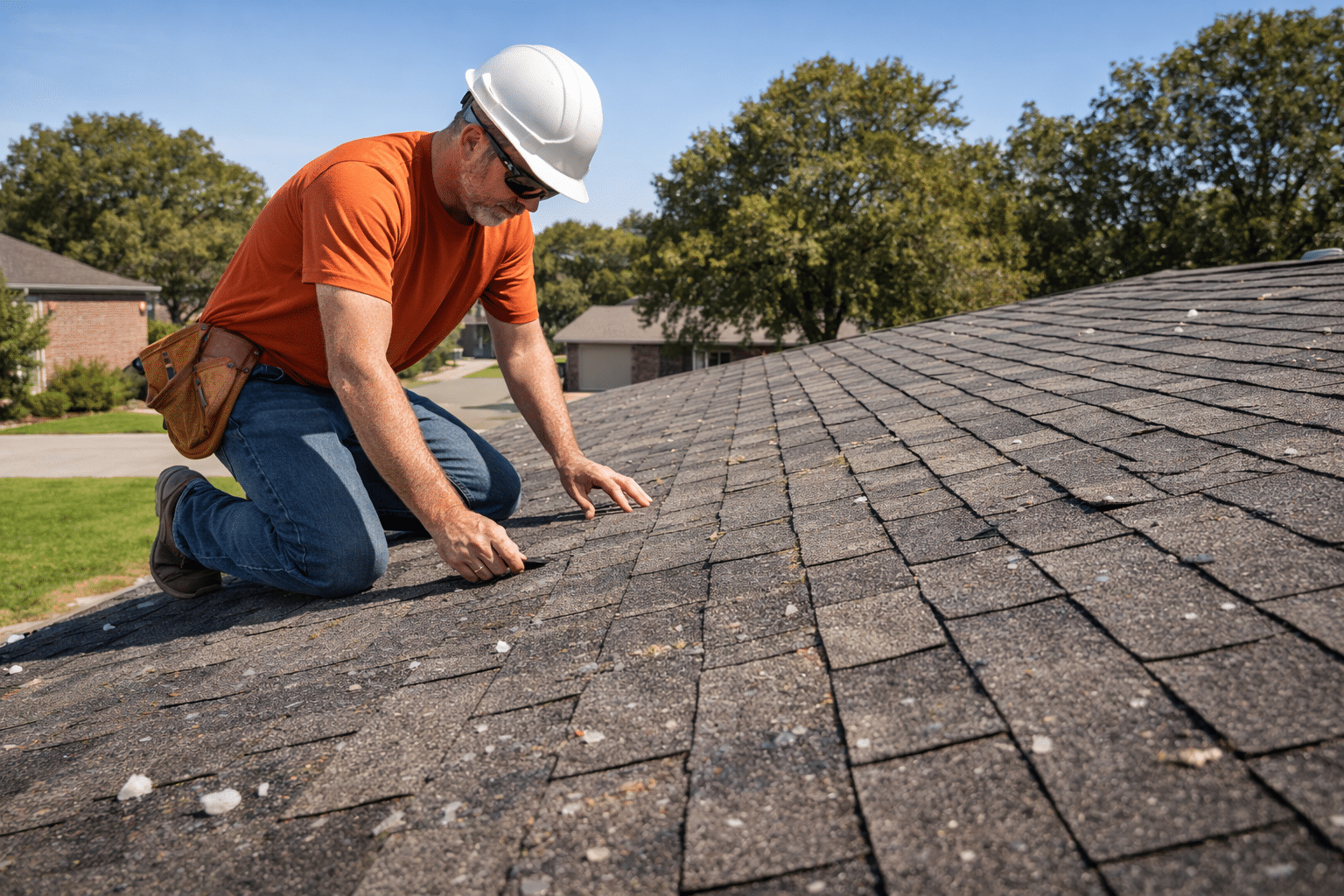
Their scope is typically driven by hit count per square (a 10×10 foot section of roof). Industry standards vary, but a common threshold is 8-10 functional hits per square as a guideline for replacement. The adjuster documents the hits, photographs the damage pattern, and writes a scope based on their assessment.
A few things worth knowing going into that inspection:
- You are allowed to have your own contractor present during the adjuster’s inspection. A second set of eyes can catch damage the adjuster misses.
- Adjusters use industry estimating software (Xactimate is the most common) to price the scope. The numbers are not negotiable in the same way a contractor bid is — but the scope itself is.
- If the adjuster’s scope only covers part of the damage, you can ask for a re-inspection or provide documentation from your contractor supporting a broader scope.
What to Do If You Disagree With the Adjuster’s Scope
This situation comes up. The adjuster says repair. Your contractor says replacement. The gap between those two scopes is real money.
Here are your options:
- Request a re-inspection. If your contractor documents damage the adjuster did not account for, submit that documentation and ask the carrier to take another look. New photos, contractor reports, and specific documentation of missed hits are the most useful inputs here.
- File a supplemental claim. If additional damage surfaces after the original claim is paid — which happens when repairs are underway and more damage becomes visible — you can file a supplemental claim. Texas law allows this.
- Invoke the appraisal clause. Most Texas homeowners policies include an appraisal provision. If you and the carrier cannot agree on the value of the loss, both parties hire an independent appraiser, and those two appraisers select an umpire. The umpire’s decision is binding. This is not litigation — it is a policy right. Read your policy to confirm it is available to you.
- Contact the Texas Department of Insurance. TDI handles consumer complaints against carriers. If you believe your claim was improperly handled, a formal complaint is an option.
One important note: do not sign anything with a contractor that assigns your insurance claim rights to them (an Assignment of Benefits). This transfers control of your claim away from you. In Texas, that practice has been linked to disputes and inflated invoices. Sign work authorization agreements — not AOB agreements.
Frequently Asked Questions
Will homeowners insurance cover a full roof replacement in Texas?
It depends on your policy. If your policy pays on a replacement cost value (RCV) basis and the damage is extensive enough to warrant replacement, yes — minus your deductible. If your roof is covered on an actual cash value (ACV) basis, the payout will be reduced for depreciation, and you will likely owe the difference.
What is the difference between RCV and ACV for a roof claim?
RCV pays what it costs to replace your roof with similar materials at today’s prices. ACV pays the depreciated value of your roof at the time of the loss. On an older roof, the ACV payout can be significantly less than the actual replacement cost — leaving a gap you have to cover out of pocket.
Can insurance deny a roof replacement if my roof is old?
They cannot deny coverage for storm damage, but they can limit the payout based on your roof’s age. Many Texas carriers use age-based depreciation schedules for roofs. If your roof is past a certain threshold — often 10 to 15 years depending on the carrier — the policy may only pay ACV regardless of the base policy type.
Does insurance have to match my roof if only part of it is damaged?
Not automatically. Texas does not have a statewide matching law that requires insurers to replace an entire roof for color matching purposes. Some policies include a matching endorsement that addresses this — most standard policies do not. Ask your agent whether your policy includes this provision before a claim forces the question.
What can I do if the insurance adjuster says repair and my contractor says replacement?
You have several options: request a re-inspection with documented evidence of additional damage, file a supplemental claim if more damage surfaces during repairs, invoke the appraisal clause in your policy to get an independent assessment, or file a complaint with the Texas Department of Insurance if you believe the claim was mishandled.
Know What You Have Before You Need It
The time to find out whether your policy pays RCV or ACV — and whether your roof age affects that — is not the day after a hail storm. It is today, while everything is calm.
I am happy to walk through your current coverage with you and give you a straight answer on what you actually have. No sales pressure. Just a clear look at your policy before the next storm season arrives.
Request a policy review or get a quote here.
David Offutt is a licensed insurance agent (TX License #1465807) based in Fort Worth, TX. He is the co-author of Understanding Insurance in Simple English and the founder of Texas Real Estate Academy, where he teaches insurance continuing education to Texas real estate agents.